


Billable utilization is a simple metric with a significant impact on a professional services firm's financial health. Firms that manage utilization effectively generate greater revenue and profitability than those that do not. More than just a productivity measure, utilization is one of the clearest indicators of a delivery organization's ability to convert capacity into revenue.
When billable utilization declines, margin pressure typically follows. Because professional services firms often operate with modest gross margins, even a small decrease in utilization can quickly erode profitability and, in some cases, lead to operating losses.
Conversely, when billable utilization is unrealistically high for an extended period, delivery quality and team morale often suffer. Team members can begin to feel perpetually behind, with little opportunity to recover, recharge, or take time away from work.
What is utilization?
“Utilization” can be viewed as an umbrella term for how effectively a firm leverages workforce capacity. It refers to the share of available working time spent on a defined category of work, expressed as a percentage.
The general utilization formula is: worked hours in a period divided by the available hours in that period. That result is then multiplied by 100 to derive a percentage.
Time tracking
It is impossible to properly calculate utilization unless the firm is disciplined about time tracking. Accurate time tracking is a fundamental component of profitably scaling a services firm. Proper time tracking enables the calculation and evaluation of numerous productivity and financial metrics.
All time tracked by a professional services firm will generally fall into one of the following categories:
- Client Billable - Hours on client engagements that are generating revenue.
- Client Non-Billable - Hours on client engagements that are not generating revenue.
- Internal Productive (or Strategic) - Hours on internal projects that have been deemed vital for the business.
- Internal Other - "Bench time" or hours on internal projects that have not been deemed vital.
- Time Off - Hours associated with time away from work such as PTO, vacation, sick leave, or holidays.
Most professional services firms of scale leverage a Professional Services Automation (PSA) platform, and one of the fundamental features of such a platform is time tracking.
Four common types of utilization
Professional services firms often track multiple types of utilization to best understand how time is being spent. Below are four of the more common types of utilization metrics.
- Billable Utilization - Only includes billable time in the numerator. The formula is (Client Billable Hours / Capacity Hours) * 100.
- Client Utilization - Includes all client-focused time, including non-billable client time, in the numerator. The formula is ((Client Billable Hours + Client Non-Billable Hours) / Capacity Hours) * 100.
- Productive Utilization - Includes all client-focused time plus time on internal projects that have been deemed strategic. The formula is ((Client Billable Hours + Client Non-Billable Hours + Internal Strategic Hours) / Capacity Hours) * 100.
- Total Utilization - Includes all client-focused time and all internal time. The formula is ((Client Billable Hours + Client Non-Billable Hours + All Internal Hours) / Capacity Hours) * 100.
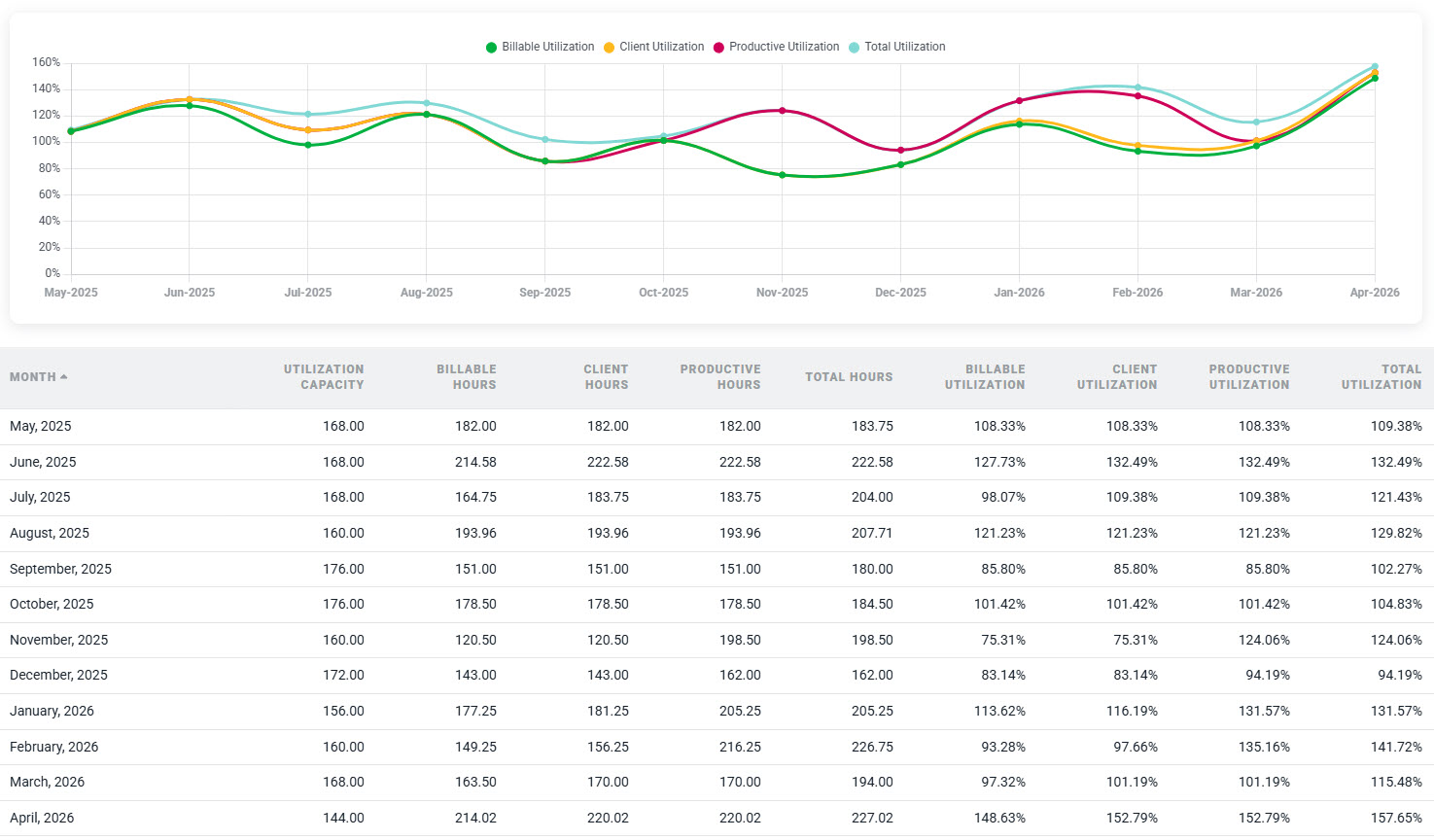
Why track four types of utilization? Because each tells a different story, as explained below:
- Billable utilization is focused solely on revenue-generating time and is by far the most commonly tracked utilization metric. For companies that primarily bill on an hourly (time and materials) basis, billable utilization is the best indicator of revenue, profit, and margin.
- Client utilization essentially tells you how much time was spent on all types of client work. Let's say an employee with a 75% billable utilization target only had 50% billable utilization in a given month. That seems like poor performance but you dig deeper and find that the project ran out of its billable hours budget and the team member was forced to track remaining time to a non-billable task. The 50% billable utilization was actually 100% client utilization.
- Productive utilization includes all client time as well as time spent on important internal projects. Key team members are sometimes tasked with delivering a vital internal initiative such as a new corporate website. Those internal projects diminish billable and client utilization but productive utilization reflects that high-value activity.
- Total utilization includes all time other than time off.
So, each utilization variant helps you evaluate performance through a different lens.
Time-off adjusted utilization metrics
In addition to tracking multiple types of utilization, it is important to evaluate time-off adjusted versions as well. A time-off adjusted utilization metric removes any time off (such as vacation) from the denominator of the formula. This helps you gain a more realistic perspective on how productive someone was given the hours that they were actually available to work.
For example, let's assume that an employee with a 75% billable utilization target billed 80 hours in December and there were 160 hours of capacity. This employee delivered 50% billable utilization which means they missed their billable utilization target by a wide margin. But, you investigate further and find that the employee took two weeks of accrued vacation during the month and thus the time-off adjusted billable utilization was actually 100%. The employee billed every single hour of available capacity during the month.
If we evaluate an employee's billable utilization without considering time off, we simply cannot gain an informed perspective on how productive that employee truly was during the period. By considering time off, we have a much more accurate view.
If you aren't evaluating time-off adjusted utilization figures, you are penalizing team members for taking their vacation. That isn't an effective way to manage a delivery operation and it simultaneously diminishes morale.
The financial impact of missing billable utilization goals
Take a consultant at a US professional services firm, billed out at $175 per hour — a typical rate for small-to-midsize consulting or IT services firms.
In a 160-hour month and with a 75% billable utilization target, that works out to a goal of 120 billable hours. At the $175 rate, those 120 hours yield $21,000 in billable revenue. Over the year, holding 75% steady, that single consultant generates $252,000 in billable revenue for the firm.
Now, assume that same consultant only delivers 68% billable utilization. The drop looks minor on a dashboard, only seven points and a handful of hours per month. But, across the year the cumulative impact is meaningful:
- 146 fewer hours billed on the year
- $23,100 less revenue for the year
Scale that same type of miss across 50 delivery personnel and the math gets more uncomfortable. It is over $1.15M in lost revenue. That type of miss can easily cause the firm to operate at a loss for the year.
No invoice short-pays. No client cancels. Just weak utilization target attainment causing a massive revenue shortfall.
This is why a seemingly small billable utilization miss of a few points gets discussed at the Board-level in well-run services firms. Such a miss can decimate revenue and profitability.
What is a good billable utilization rate for a consulting firm?
Any metric defined as 'good or bad' depends on multiple factors.
In this case, for billable utilization, it depends on at least three: role, service model, and margin structure.
The mistake most firms make is skipping that nuance — they grab one benchmark, announce that everyone should hit it, and then wonder why the metric creates bad behavior.
A trustworthy source for professional services benchmarks is Service Performance Insight (SPI Research). Their 2026 Professional Services Maturity Benchmark groups firms into five maturity levels based on operational discipline across leadership, finance, talent, service execution, and client relationships.
Billable utilization tracks closely with that maturity:
Three things stand out:
- Lower maturity levels show low billable utilization — clear room for improvement in the early stages of a firm, where structure and tooling are still being built.
- The middle of the market sits at 66–74% billable utilization. That is the realistic working range for a typical project-based professional services firm.
- Higher utilization correlates with higher firm maturity — not because mature firms push their teams harder, but because they have the data visibility, resource management, and operational structure to scale without overloading anyone.
The takeaway is not "aim for 81%". It is that billable utilization is a signal of operational maturity built over time, with clear data visibility, well-defined margins, and good resource management. It is not a target to chase in isolation.
Firms that run well at 80%+ got there by improving everything else first.
Note that firms that run a staff augmentation model tend to have higher target billable utilization figures. A "staff aug" firm generally has much lower bill rates than a project-based consulting firm. Given the lower bill rates and ultimately gross margin, the staff aug firms usually need to run at or above 90% billable utilization. Consultants are staffed full-time on client engagements for many months (or sometimes years) in a row.
Role mix matters more than the headline number
The benchmark numbers above are firm-wide averages. Inside any firm, roles do not deliver the same work and should not carry the same target:
- Mid-level consultants carry the highest targets. Client delivery is most of what they do.
- Senior consultants and managers run lower, because their time is split between billable delivery and mentoring, scoping, and oversight.
- Practice leaders and directors run lower still — they own pipeline, hiring, and account expansion.
- Partners and principals run the lowest, because their job includes sales, leadership, and client relationship nurturing. Their value to the firm is not measured by their own billable hours.
A flat target for everyone across the firm ignores these dynamics and is not recommended.
Targets should back into your margin, not copy a benchmark
The more useful question is not "what is the right billable utilization target?" It is "what billable utilization does each role need for our firm to achieve its budget margin?"
Higher-bill-rate firms can hit their target margin at lower billable utilization.
Lower-bill-rate firms (such as the staff aug firms mentioned above) need higher utilization to make the same margin.
That’s why a strategy boutique billing $400 an hour does not need its senior consultants at 80% billable utilization to be profitable, but a digital agency billing $125 an hour has much less room for non-billable time.
The right way to set a target is to start from the gross margin goal and work backward: what billable utilization does each role need to hit for the unit economics to work?
That calculation produces role-specific targets that actually serve the business. Picking a number off a benchmark does not.
The mistake firms make with billable utilization
You can now understand that the most common mistake is treating utilization as a universal performance score.
It is not.
Billable utilization is a business metric first. It becomes a people metric only when used carefully and in context.
If leadership sets one flat target for everyone, a few bad things usually happen:
- Senior people avoid important non-billable leadership work.
- Teams hide internal effort instead of improving it.
- Time entry gets distorted because people optimize for the metric, not for the business.
- Burnout risk rises while reporting quality falls.
A better approach is to define billable utilization by role and connect it to firm economics.
Ask:
- What billable utilization level does each role need to support our margin goals?
- How much non-billable time is healthy and necessary?
- Which internal work is strategic, and which is just operational drag?
That is a much more useful conversation than asking why everyone is not at 82%.
How to improve billable utilization rate without burning out the team
Improving billable utilization should mean removing waste, not squeezing people harder.
A few practical moves usually have the biggest impact:
- Ensure that the sales team is delivering the right volume of new clients and contracts.
- Tighten resource planning so the right people are staffed earlier.
- Ensure that the recruiting team is not adding new personnel too far out in front of demand.
- Reduce time lost to spreadsheet reconciliation and manual reporting.
- Catch scope drift before it turns into invisible non-billable work
- Watch the gap between client utilization and billable utilization - when client utilization runs higher, the team is doing client work that is not being invoiced.
- Make time entry easier so the source data is accurate and timely.
- Review billable utilization alongside margin, backlog, and forecasted demand.
This is where systems matter.
If your firm is still stitching together time tracking, resourcing, project financials, and forecasting across disconnected tools, billable utilization will always be harder to trust and harder to act on. You will spend too much time debating the number and not enough time improving it.
Why billable utilization matters for consulting firms
As we have seen with real numbers and examples, billable utilization sits close to revenue, gross margin, and capacity planning.
A drop does not just mean people were less busy. It often means one of three things:
- Demand is softening.
- Scheduling is poor.
- Too much valuable time is getting eaten by non-billable work.
That is why billable utilization should never be read in isolation.
A team can have high billable utilization and still underperform if realization (invoice write-offs) is weak or projects are overrunning. A team can also have temporarily lower billable utilization for good reasons, such as onboarding new hires ahead of demand or investing in capability building for a fast-growing practice.
Still, there is a reason billable utilization shows up again and again in services leadership discussions. When firms say things like "we have too much bench time," "our utilization is all over the place," or "we do not know which roles we should be recruiting for right now," billable utilization is usually at the center of the issue.
See your billable utilization clearly — All in one place
The firms running at the top of the SPI maturity curve are not working harder. They have the visibility, resource planning, and reporting to spot the problem before it shows up in next quarter's revenue.
Ruddr was built for exactly that — a single system for time, resourcing, project financials, and billable utilization reporting, designed for consulting firms that have outgrown spreadsheets and stitched-together tools.

